Sunday, January 6, 2019

SAY A PRAYER WHEN YOU TAKE DOWN THOSE CHRISTMAS DECORATIONS AWAY

Image result for putting away decorations prayer

Adapted from unknown author for the purpose of sharing to inspire others. May we live the grace of Christmas every day ..

Traditionally, Catholics do not take down their Christmas trees and holiday decorations until January 7, the day after Epiphany. The 12 days of Christmas begin on Christmas Day; the period before that is known as Adventthe time of preparation for Christmas. The 12 days of Christmas end on Epiphany, the day that the three wise men came to pay homage to the child Jesus.

Catholics have different strategies for putting Christmas decorations away, but it is always a bittersweet day.Some choose the Octave Day of Christmas, January 1. Some choose the 12th day of Christmas, the eve of the Epiphany, or January 6, the feast of the Epiphany.Others wait all the way until the last feast of the infancy of Christ — the Presentation, February 2. Some families, on the last day of the liturgical Christmas Season, the feast of the Baptism of Christ (January 13 this year)Here is a prayer you can print it out and hung it as a reminder all year long.

Prayer for Putting Away Christmas Decorations


Lord Jesus, today we have put all of our Christmas decorations away. We are entering into Ordinary Time, and our house looks “ordinary” again, too.But Lord, you know and we know that our house has a secret. Deep inside it, all of our Christmas decorations are still here. The blessing of Christmas is always with us, kept in the deep, quiet places of the house.And Lord, our lives will become ordinary again, too, but you know that each of us has the grace of baptism. The grace you gave us is always with us, in the deep, quiet places of our soul.May we live the grace of Christmas every day, only without all the trappings: May we always give generously, receive gifts gratefully, welcome others, and study your life.Make our house be a home with Christmas at its core, and our souls a home where Jesus always dwells.Amen.

AN EPHIPANY HOUSE BLESSING- How to do it

Image result for how to bless your home with epiphany chalk

It is a powerful blessing that lasts the whole year.

Each year around the feast of the Epiphany many parishes throughout the world participate in an annual blessing of chalk. It is an ancient tradition that not only places God at the entrance of your home, it places your entire family under his protection.
The Epiphany blessing of chalk and homes is a centuries old tradition where priests would visit each home in their parish after the Feast of the Epiphany. Over time it became more difficult to accomplish such a feat as parishes became larger and larger and priests were stretched thin. For this reason it became an accepted tradition that a member of the household is able to lead this blessing in place of the priest.
The blessing has biblical roots, deeply tied to the Passover in the book of Exodus.
The Lord said to Moses and Aaron in the land of Egypt … “take some of the blood [of the lamb], and put it on the two doorposts and the lintel of the houses in which they eat them. They shall eat the flesh that night, roasted; with unleavened bread and bitter herbs they shall eat it … The blood shall be a sign for you, upon the houses where you are; and when I see the blood, I will pass over you, and no plague shall fall upon you to destroy you, when I smite the land of Egypt.” (cf. Exodus 12:1-13)
The family gathers to ask God’s blessing on their home and on those who live in or visit the home. It is an invitation for Jesus to be a daily guest in our home, our comings and goings, our conversations, our work and play, our joys and sorrows.
A traditional way of doing this is to use chalk to write above the home’s entrance, 20 + C + M + B + 16. The letters C, M, B have two meanings. They are the initials of the traditional names of the three magi: Caspar, Melchior, and Balthazar. They also abbreviate the Latin words Christus mansionem benedicat, “May Christ bless the house.” The “+” signs represent the cross and 2016 is the year.
Blessing the Chalk
V. Our help is the name of the Lord:
R. The maker of heaven and earth.
V. The Lord shall watch over your going out and your coming in:
R. From this time forth for evermore.
Let us pray.Loving God, bless this chalk which you have created, that it may be helpful to your people; and grant that through the invocation of your most Holy Name that we who use it in faith to write upon the door of our home the names of your holy ones Caspar, Melchior, and Balthazar, may receive health of body and protection of soul for all who dwell in or visit our home; through Jesus Christ our Lord. Amen.
Instructions for Blessing the Home
Using the blessed chalk mark the lintel of your front door (or front porch step) as follows:
20 + C + M + B + 16 while saying:
The three Wise Men, Caspar, Melchior, and Balthazar followed the star of God’s Son who became human two thousand and fifteen years ago. May Christ bless our home and remain with us throughout the new year. Amen.
Then offer the following prayer: Visit, O blessed Lord, this home with the gladness of your presence. Bless all who live or visit here with the gift of your love; and grant that we may manifest your love to each other and to all whose lives we touch. May we grow in grace and in the knowledge and love of you; guide, comfort, and strengthen us in peace, O Jesus Christ, now and forever. Amen
“Chalking the door” is a way to celebrate and literally mark the occasion of the Epiphany and God’s blessing of our lives and home. With time the chalk will fade. As it does we let the meaning of the symbols written sink into the depths of our heart and be manifest in our words and actions the Latin words, Christus mansionem benedictat, “May Christ bless the house.”
After the prayers of the blessing are recited, walk through the house and bless each room by sprinkling with Epiphany/holy water and incensing it.
Take the blessed chalk and first write the initials of the three Wise Men, connected with Crosses, over the inside of your front door (on the lintel, if possible). Then write the year, breaking up the numbers and the year so that they fall on both sides of the initials. It should look like this, for example
20 C+M+B 19
with the “20 “being the millennium and century, the “C” standing for the first Wise Man, Caspar, the “M” standing for Melchior, the “B” standing for Balthasar, and the “19” standing for the decade and year. It is also popularly believed that the Kings’ initials stand for “Christus mansionem benedicat” (“Christ bless this house”).

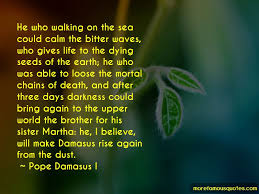
SAINT DAMASUS PRAYER

From the Decree of Damasus (attributed to Damasus):


The arrangement of the names of Christ, however, is manifold: Lord, because He is Spirit; Word, because He is God; Son, because He is the only-begotten son of the Father; Man, because He was born of the Virgin; Priest, because He offered Himself as a sacrifice; Shepherd, because He is a guardian; Worm, because He rose again; Mountain, because He is strong; Way, because there is a straight path through Him to life; Lamb, because He suffered; Corner-Stone, because instruction is His; Teacher, because He demonstrates how to live; Sun, because He is the illuminator; Truth, because He is from the Father; Life, because He is the creator; Bread because He is flesh; Samaritan, because He is the merciful protector; Christ, because He is anointed; Jesus, because He is a mediator; Vine, because we are redeemed by His blood; Lion, because he is king; Rock, because He is firm; Flower, because He is the chosen one; Prophet, because He has revealed what is to come.
From The Faith of the Early Fathers , by William A. Jurgens, Copyright 1970, the Order of St. Benedict, Collegeville, Minnesota
In His Footsteps:
Damasus' love and respect for Scripture is shown in his authorization of the Vulgate translation. Spend 30 minutes today reading and meditating on Scripture. Try to make this a daily habit. One way to do this is keep a Bible open by your bedside and read it first thing in the morning and last thing before you turn out the light at night.
Prayer: Saint Damasus, instead of worrying about the short term of life on earth, you took God's view and looked to the things that last. Pray for me that I may be able to look beyond immediate popularity and fleeting favors, and choose to do the things that God wants me to do. Amen


WHAT IS THE BLACK NAZARENE?


The Black Nazarene is a life-sized image of a dark-

skinned, kneeling Jesus Christ carrying the Cross

enshrined in the Minor Basilica of the 

Black Nazarene in the Quiapo district of the City of 

Manila, Philippines. Wikipedia

Location: QuiapoManilaPhilippines

Holy See approval: Pope Innocent XPope Pius VII


THE FEAST OF THE BLACK NAZARENE IN THE PHILIPPINES


I want to share with you an article about the celebration of the FEAST OF THE BLACK NAZARENE IN THE PHILIPPINES. See the link provided below for the whole story and a video.
Here it is:

Jan. 9: FEAST OF JESUS THE BLACK NAZARENE (Philippines). AV prayer & text

Dear brethren in Christ, on Jan. 9, the first novena feast, official transfer and enshrinement of Jesus, the Black Nazarene on 1787 at the Minor Basilica of the Black Nazarene in Quiapo, Manila (Philippines) will be commemorated. The yearly celebration showcases the gathering of several millions of Filipino devotees of the image along its almost 4.3 mile processional route, lasting for 19 hours, which most of the attendees do it barefoot.

“The image was carved from a dark wood around the 16th century in Mexico by a group of Spanish Augustinian Recollect friars, and then transported to Philippines in 1606. It depicts Jesus en route to his crucifixion. Pope Innocent X granted to recognition to the lay Confraternity of Santo Cristo Jesus Nazareno in 1650 for the promotion of devotion to Jesus under this image. It was housed in several churches near Manila in the early decades, reaching the Quiapo church in 1787 where it has been ever since. The icon is renowned in the Philippines, is considered miraculous by many Filipino Catholics who believe that just touching it cures diseases.” (1)

The image is currently enshrined in the said Minor Basilica, where it is venerated every Friday with Novena and Holy Masses and is one of the most popular devotions in the Philippines, together with Santo Niño de Cebú and Mother of Perpetual Help in Baclaran, Manila.

Below you have a prayer to the Black Nazarene. Cordially inviting you to like our page, www.facebook.com/Catholicsstrivingforholiness so we could have a wider apostolic reach and help more people in their Christian life. Thanks and God bless!
Fr. Rolly Arjonillo.

PRAYER TO OUR BELOVED JESUS, THE BLACK NAZARENE

Beloved Lord Jesus, Black Nazarene,
we come to you to help us.
 Life is a constant struggle,
and we now feel the pain of our journey.

Bless us Jesus and teach us to listen
 to You in all the events of our life,
knowing that nothing happens by chance.
Everything that happens has a reason.


When we feel the pain of sickness,
teach us to cope with loving surrender,
to unite ourselves with You on the Cross,
 and to believe in the power of healing.

When we experience emotional,
financial and psychological brokenness,
and all types of difficulties,
 help us to rise up with belief that with God,
nothing is impossible.

We come to you today,
to pray for healing and
to ask your mercy:
Jesus, to listen to our petitions
(say petitions...)

We pray to You with the help of our Mother Mary
to answer our prayers amen.

Jesus, the Black Nazarene
we put our trust in you!

VIVA, JESUS NAZARENO!

AUDIO CREDIT: Kevin Macleod, Consort Brass, incompetech.com.

Go to this link for the whole article amd to view the video:
https://m.facebook.com/story.php?story_fbid=1156853737824955&id=428443983999271

Featured Post

Prayer to Saint Michael the Archangel: Full Prayer, Meaning, History & Catholic Guide

  Saint Michael the Archangel, Prince of the Heavenly Hosts, defend us in battle and protect us from the powers of evil. Prayer to Saint Mic...

Popular Posts